Thursday, 8 March 2012

Bunker, storm cellar, root cellar or safe room...

Call it what you like and dependant on where you are it might well be a storm cellar or be used as a safe room but it amounts to the same thing.

It's your sturdy, secure and save haven. Now if you're a zillionaire it might well be some mountain fortress with feet thick reinforced C90 concrete walls built many 100's of feet under a million tons of granite. For most of us it's the best you can do, with what you have and what you can spend on it.

There are many forms. Fibreglass, free standing, solid steel, made from drain culverts but it usually tales the form - at least when we think of a typical one - of a 50's Atom shelter.

Regardless of whatever your means and locale pick the best for you. Make the best of whatever option you have.

One idea, using shipping container design as the basis is so-called 'blast resistant buildings' or modules. 

As I say make the best of what you have and within your budget. Oh, one final aside: do not make your doors so thick (5 feet) or heavy (350 ton) that they take a whole 24 hours to close as per a certain Swiss tunnel cum shelter. A tad too much me thinks.

Using a potential property I may be about to purchase I have either a cellar (I'm not sure it has one), an under patio option (possible but too close to the house if it was knocked over) or under a nearby outbuilding. It has a HUGE hill close by which affords some natural protection - if only from potential blasts. Ideally I'd own a patch of land half way up and dig in. 

Let's argue that I go under the patio (so entry is outside the house). I'll not have much to play with - say the width of the house less wall by the depth of the patio. At a guess 12 x 12. Allow for wall thickness and you're looking at 10 x 10. Not exactly perfect but more than enough to store and secure.

Sunday, 26 February 2012

Lock down.

One suggestion, worth thinking about, mentioned in a preppers book is staying hidden. By that I mean they suggest that if you've decided to stay in a place visible - say in an urban environment - and you're well prepared come what may, then allowing one and all to see your working lights, water and food storage is a mugs game.

It takes two forms.

In the first by allowing neighbours etc to see how you prepared ahead of time you've made them aware that you're the go-to guy to 'borrow' stocks from. Share if you wish but if you do not then stock pile with half an eye on NOT letting all and sundry know what you've got. So later night or super early deliveries, small amounts built up over time and the like are the way to go. Ditto buying from a town over rather than locally.

The other form is post shit time. Don't have your noisy generator outside working away and powering visible to one and all lights and heat. Use smokeless fuels and filters which keep any such energy generation down.

So blackout blinds and silent running generators are a must. 

A third form, not often considered, is staying hidden by joining those remaining. In other words it's suggested you make like your as fucked afterwards as everyone else. Hell one could even argue that the ability to top up your stocks with whatever you can scavenge is, in fact, a good idea. So a scouting of local food sources (shops??) after the law fails (best avoided before for legal reasons) and assuming no one else has beaten you to it is one to be considered. Remember, as always, rotation. So if the local Bookers warehouse has food left get in there!! You will, of course, need to use the lock down rules. Do not think that, post SHTF, you dragging a ton of food back to your refuge in an urban setting is not going to be noticed by those going without around you.

Water!!

It's been written often enough - without water we're screwed in days. Without food - weeks? The bigger and heftier we are the worse it gets with thirst and the better, by degrees, with food. All things being equal I'd like plenty of both thanks.

With that in mind - water. One prepping boos suggest, rightly so, that ANY clean container, including old soda pop bottles - once cleaned, will do. True. But obviously we want as much stored as is reasonable along with the means to collect rain water, have a well and or sterilise it.

Now in an ideal scenario we'd have our own well or water source (stream, river or what-have-you). Most survival refuge selling sites (survivalrealty.com being the main one) have a measure of how many gallons per minute said well or water source can and does provide. Ditto your central heating system - they use the same measure. 

Make sure you have means of storing water (I'd suggest two large tanks), collecting water (a water butt from down pipe off of your roof) and filters and chemicals to clean and sterilise water with. Water boilers included. Of the images I've added my preference is for the 2nd tank as it's easy to use a pallet truck with and thus moveable.

Of the filters I'd prefer the kind where, as your water source comes in, it does it's job. Equally and you might prefer such a set up, the kind where you store your water as is and filter it when you need it is ok. But it is a slower way of being ready than a drip-feed system. Look also at sterilizing solutions and tablets.

Some products and containers can and do leave a taste. Better to be moaning about how the water tastes than be thirsty eh?

Water butts are, for how they might save your life - or at the very least water your crops, wash clothing or property (as opposed to be used for drinking if you have a better source  - cheap as chips. The kind were all surplus water spills over is spot on. A 210-gallon version is a tad over 30 bucks.

Consider using 2nd hand versions of the above if they have been professionally cleaned and are intact and good to go.

Saturday, 25 February 2012

Other stuff to horde and more...

On survivalist sites there are some very good lists. The US based ones do, it seems, become a little over done when it comes to the subject of weapons. 20000 rounds, six guns and the rest and that's per person. Based here in the UK we're a little more basic. While defence, as an issue, may well raise it's head at some point I'm more inclined at this time to think of stuff like toilet rolls and light bulbs.

With that in mind other than food and water look around your home now and think about what you'd need if it all went to shit. 

  • Clothing inc lots of socks and underpants. Unless you have sheep and can knit, sew, darn and make your own clothing stash plenty of good kit
  • Toilet tissue and sanitary towels. I'd say 99.9% of the lists I've seen suggest this one and my preference is for the economy kind. If you ran out and had the means to wash cloths then use a cloth. Otherwise stash a good supply.
  • Spares!! From light bulbs (given that you have power naturally) and fuses (ditto) to sink plugs - look around your abode and think carefully about what breaks or gets worn out and that you'd have a hell of a time finding afterwards.
  • Medical kits, tablets and so on. When the shit comes down your local A&E will be overwhelmed and then fail. We see news reports on occasion now of a lack of blood and plasma. After... nowt. Ditto your local chemist. So read up on what you'd need and stockpile. Be aware that in some products the shelf life is limited. Use the same storage precautions you might for spoil-able food and so chill, keep away from bright light and so on. In the case of some products they are less effective as opposed to not at all. Those of you with very specific medical conditions requiring a high level of care might well be screwed - do what you can. Even a few brushes and combs can be kept as spares.
  • Paper! When the shit etc occurs you'll not have emails. Taking a step back and finding yourself using, initially, white boards, paper and even chalk to communicate both inside the refuge and without and you'll appreciate the paper and pens you stashed. 
  • Repairs. I'll deal with tools and the like another time but what about putty, filler, nails and screws? Need some glue? Have some stashed?? Your new safe haven does not have to be a palace but keeping it and esp the means to secure it in good nick makes sense right? So stash what you need to keep it that way. 
Look at the photo on this page: do you have spare batteries for the torch? What about filters for the water purification system, more razors for shaving, another few pairs of gloves? That's just one bag. So go look at your refuge kit and add spares!

Friday, 24 February 2012

Food and Storage pt 1

In days of old, as many books used to start, they had root cellars. In prepping terms we want to hold as much food stuffs, among other things we'll get to later, as we can. 


It's important to store said items in as best a condition as possible. Also be aware that you use, when TSHTF comes down, perishables first. It might mean one hell of a BBQ when the power goes and you eat all the meat in your deep freeze but enjoy it while you can. Ditto some forms of fruit and veg. Prepping has you pickle and preserve fruit and veg. It has you bucket up grains, rice, flour and sugar and it has you tin, tin and tin some more. There are a bunch of sites which offer a greater in-depth view on this subject and I suggest a good search. Learn and use the info.

Food rotation
It's all well and good laying in 200 tins of food and ready meals (MRE's) but if you eat the out of date sequence you could end up discarding a valuable resource. In tough times throwing out food you might need to survive... not clever.

Shelving
Most off the shelf shelves are, to be frank, shit. Buy the heavier duty kind. I've some collection of books and magazines and have utterly demolished the lightweight versions. Either use thick wood or metal shelving with a good loading capacity. The minimum for food storage would be 30-kilos per shelf but more is better.

One company, although there might be another one or two (Can Tracker for example) which does well in this sector is 'shelf reliance'. That said, via google images, I've seen wooden home made versions that should work well enough. Also look at, if not for food rotation, at shop and warehouse shelving. They are, after all, designed to handle what you'll want them for.

As for the rooms - you're looking at the usual cool, dark and dry. That is, after all, what it says on the tin. For our purposes we also want secure. A lockable larder or pantry is the starting point. At a minimum I'd want a secure (fitted with a lock then) steel cabinet in my kitchen or garage/storage area. Ideally an area set aside in my bone dry bunker. The middle ground would be a cellar or basement. Some preppers get around the damp issue by using an old chest freezer. Fitted with a lock they are almost air-tight with their rubber seals, protected by their insulation against temperature changes and better than nothing against outside damp

Windows... a weak point.

Ok, so we've dealt with - if briefly - the ways in and out. I'll mention that I am looking for a semi commercial property myself. Indeed, as I type this, I am awaiting a response on an offer. Fingers crossed. Anyway, one of it's redeeming features (other than an awesome price and massive square footage) is a lack of any windows on the ground floor. 

In keeping with what some call 'modern day castles' when referring to refuges and the like (and with reference to suggestions of Max Brook's and removing access to upper floors) this property has, as above, no windows I can recall on my viewing downstairs. Certainly not in the part I wish to own. It has, I think, three ways in/out including two security exit style doors and the main entrance. There may be an additional way in or out via access to the cellar. In keeping with commercial warehouses and the like they are simple structures, usually open spaced but not always and with decent doors. Little or no windows. I like the idea, as it were, of living over the shop. One upper floor would suffice providing there's decent height in the ground/lower floors.

It's worth adding that said premises offer a lot more space for the money you'd pay for a more normal house. Take one example, just today mentioned on 'Homes under the hammer' (BBC TV). It was a former community hall totalling about 3000 sq ft. It was priced and went for around £100,000 (approx 2 years back). A typical British home, we are informed, is about 1000-1200 sq ft and cost, again an average, of well over £200,000. A normal house will suffice for most in terms of room so you'd have 800-1000 square foot to play with. Think about that storage and security...


One means of securing any windows, hopefully in the upper section but we'll assume up and down, is via grills. Either the solid steel bar type (sometimes in a steel frame) or the sliding gate type. It's worth noting that for both emergency access (by you) in the event of fire or similar and building regs may well mean you need to take a different approach. One, the more solid version, is far more secure than the more complicated sliding type (pictured) but equally a lot harder to escape from if needed.


Another is via shutters. There is the roller type, sometimes seen on European houses and shops/stores (esp doors into commercial premises) and the door type (inner and outer fitting). The simple fact that, with a little work, even heavy shutters will get permission if they look a little decorative and can be, for all intents and purposes, solid steel merely mare to look like a traditional form might make them the best option. In the example pictured (from another survival site of an Israeli house) they are exactly as described.

In an ideal situation you'd have some bullet proof or at the very least safety glass fitted. You can also beef up standard installations with heavy but clear safety films. 

Always bare in mind that it's the norm to have a door a truck couldn't impregnate and windows a brick can put in. Window locks are usually 10 levels down on door lock security levels and so on. Why spend all that cash on a steel front door with a 15-point locking and bolt system only to have zero extra security on your windows.

Starting with the way in and more...

Doors to your home. In my old place I had, as many do, a modern UPVC replacement type door. Now they are quite secure in the manner of their locking. But often come with the larger glass double glazed panes and panels which, as you can see on youtube, are quite 'kick-out-able'. Watch police raids. My neighbour, a dealer of sorts, had his rented house door broken into three times. The first two times, armed with their 'thumper' or whatever it's called, they were able to - with one blow - completely take out the main middle panel and step through. The frame remained secure each and every time.

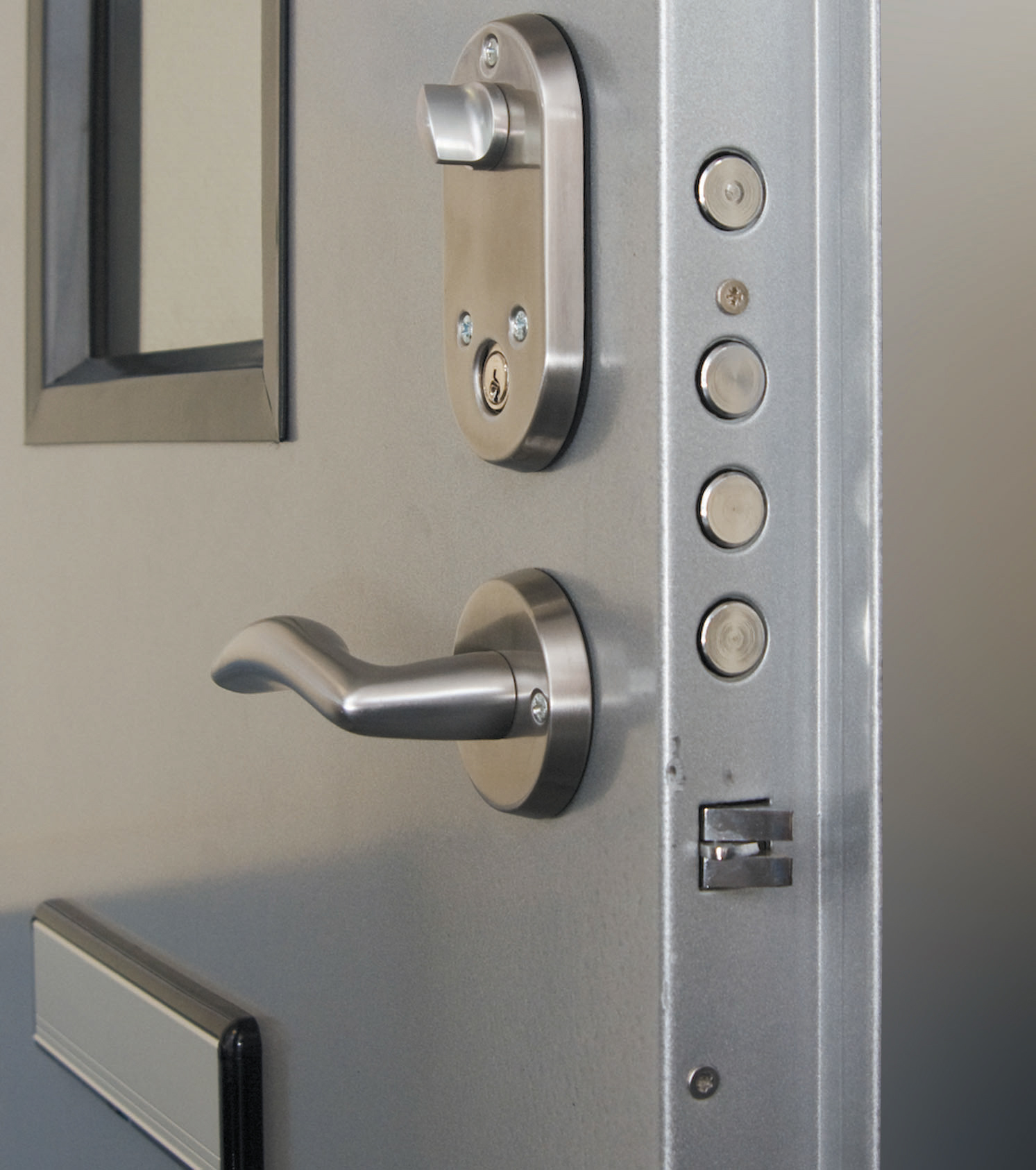
A hardwood door is, as you'll have probably seen, better in some ways but once damaged in any way... that's it. I think the best option and surprisingly not overly expensive is a steel security door with a similar, if not better, multiple locking point system to the UPVC type.  It's worth stating that few of the more economical ones are solid steel or use heavy steel plate but no door, regardless of how heavy duty, is ultimately impregnable. Also having what looks like a vault door as access to your property might attract attention as to their being something worth protecting. Many a prepper takes the view that staying less obvious helps with security.


With the 'stay secure but don't attract attention' point in mind look at outer property doors to be either the original as fitted with a more secure inner entrance or check out the doors which are as per the image above but look, for all intents and purposes, like a normal front door. Some are covered with vinyls and others with veneers. Note how, as per this coloured version, they do NOT have letter boxes. They will have a secure mailbox. Think about why...


Just day to day a good door, as above, protects what you have now. Now add in all that you'd hope to have later on... gotta be worth protecting. One suggestion I've seen is protecting sections (floors, wings and the like) of your home and refuge with a heavier door than is usually found inside houses. In other words use a good solid fire protected front door type panel to protect rooms and the like the inside. If you're lucky enough to have a panic or safe room, or better still, a NBC type bunker then by all means go the whole hog and get some 6+ inch thick steel and concrete beast to secure that.


One final thought, do not make the mistake of spending bucks on a great front door only to spend f'all on a back door or other entrances in. Our 'zombies' will get in via the weakest point to get at your hard earned goods and loved ones.